


IGEN party game
A browser-based party game where everyone plays on their own phone. The game handles the questions, the secret answers and the scoring, so the group only has to play.
The Challenge
IGEN (Hungarian for YES) is a simple game. A question is asked, everyone secretly answers YES or NO, and then everyone guesses how many people said YES.
Played with pen and paper, though, it takes a lot of handling. Someone has to collect the answers in secret, count them and keep score. That slows the game down.
The goal was a version that runs on the group’s own phones, with no download and no sign-up. The game takes care of the secret answers, the counting and the scoring.
The Solution
One player enters a name and opens a room. Everyone else joins with a short code. Two players are enough to start. A room holds up to ten. Before the game, the host sets how many rounds and how many points it lasts, and whether 18+ questions are allowed.
A round goes like this:
- Question: the player whose turn it is picks one of three questions. The others can see that they are choosing.
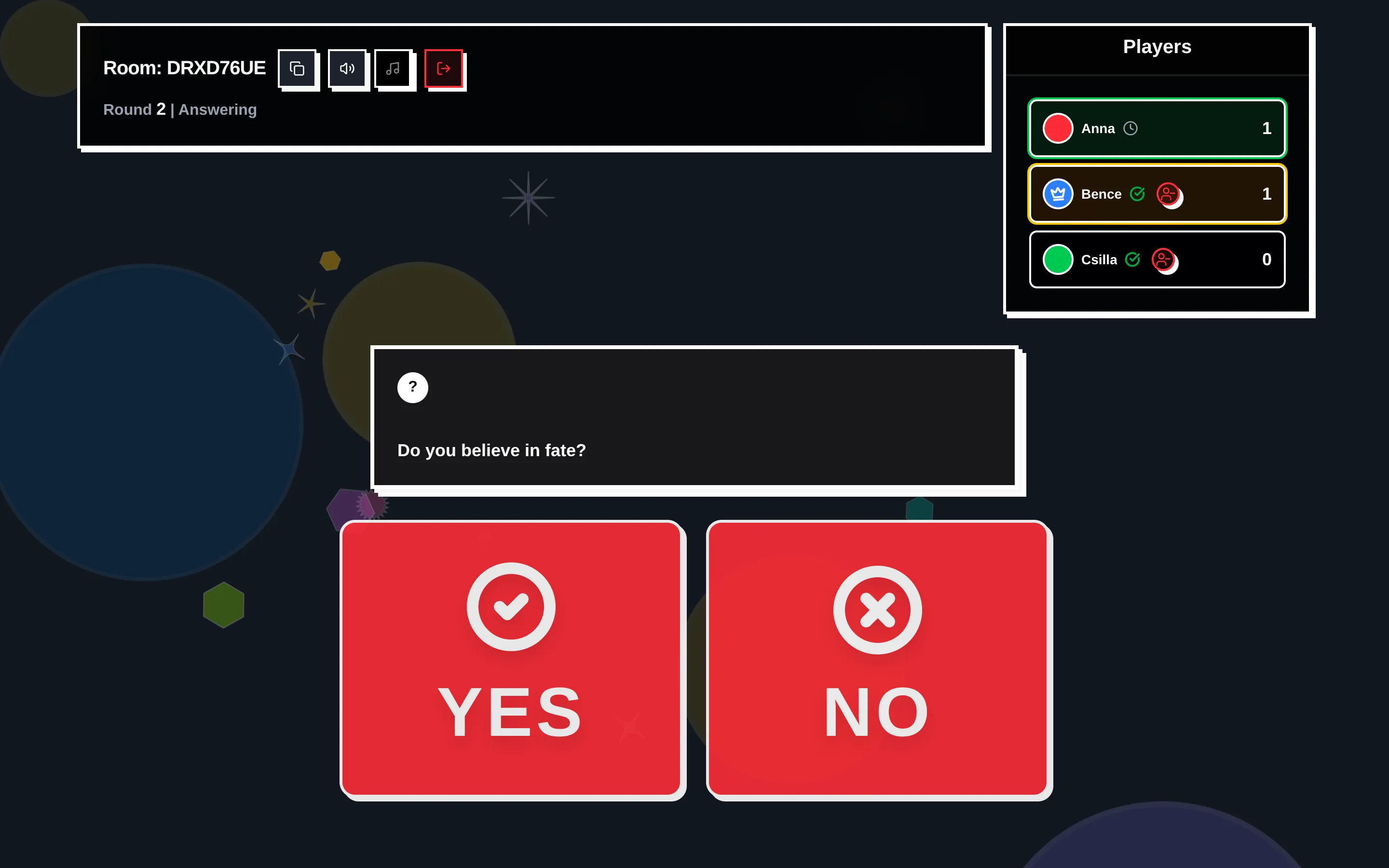
- Answer: everyone taps YES or NO on their phone, the picker included. Answers are secret. The others only see who has answered so far.
- Guess: everyone guesses how many people said YES.
- Result: anyone who guessed exactly right gets a point.
In the next round, the next player picks the question. The game ends when someone reaches the target score or the rounds run out. Then the final results appear, and one tap takes the same group back to the room to play again.
The game has 1,156 questions. No question comes up twice in one game, and next time the game first offers questions the group has not played yet. If only one phone is at hand, the questions can be flipped through without internet. The game is currently in English.
The Result
A party game that needs nothing more than a link and a code. No paper, no mental arithmetic, and nobody has to act as game master.
The harder part is behind the scenes: every phone has to show the same thing at the same moment. If someone loses their connection or closes the page by accident, they reload and are back in the room with their name and score.
The same technique works for a restaurant: an order taken at the counter shows up in the kitchen right away. Or for a shop: two colleagues can’t sell the same last item in stock.